
Graham County Arrest Records and Charges
Graham County arrest records begin with law enforcement. They may involve the Graham County Sheriff's Department, a booking event, a hold, bond questions, a court date, or a release decision. The Sheriff's Department and jail are at 410 N. Pomeroy in Hill City, and the sheriff's phone number is 785-421-2107. Research did not locate an official online Graham County jail roster, so current arrest custody questions route through the sheriff or jail rather than a county mugshot database.
Court charges after arrest are different. Once the prosecutor files a complaint, information, or other charging document in Graham County District Court, the accusation becomes part of the court charge record. That record is searched through Kansas CaseSearch, courthouse terminal access, or the District Court Clerk at 785-421-3458. For current custody and jail details, use Graham County inmate records. For the complete case file, pleas, disposition, and sentence, use Graham County criminal court records.
Find Graham County Arrest Records
Start with the question being asked. If the question is current custody, booking status, bond, or release, call the Graham County Sheriff's Department. If the question is what charges were filed after arrest, search Kansas CaseSearch or contact the District Court Clerk. If the question is a statewide criminal history, use the Kansas.gov criminal history channel. Those three routes are related, but none replaces the others.
- For current arrest or jail custody, call the Graham County Sheriff at 785-421-2107.
- For filed charges, search Kansas CaseSearch by defendant name, case number, citation, or other available criteria.
- Open the case and read each count, statute, offense name, filing date, and charge status.
- Check later docket entries for amendment, dismissal, plea, diversion, conviction, sentencing, or warrant events.
- Request certified copies or older records from the Graham County District Court Clerk if online data is not enough.
The Kansas State Board of Indigents' Defense Services is relevant when a charged person cannot afford counsel.

BIDS is not a charge lookup database. It helps explain the appointed-counsel system for people facing Kansas criminal charges.
Charges After Arrest
A charge record is the filed accusation. In Graham County, a charge can identify the offense name, Kansas statute, severity level or class, count number, filing date, prosecuting agency, and court case number. The charge may start from an arrest or citation, but it becomes a court record when filed in district court. One arrest can produce several counts, and those counts can move in different ways as the case develops.
| Complaint | Information | Indictment | |
|---|---|---|---|
| Filed By | Law enforcement or prosecutor, depending on the case stage. | Prosecutor. | Grand jury. |
| Common Use | Initial accusation or misdemeanor-style filing. | Many felony prosecutions. | Less common, used when a grand jury charges. |
| Record Role | Begins or supports the court case. | Sets the formal charge list. | Creates charges through grand jury action. |
| What to Check | Count, offense, statute, alleged date, and filing date. | Amended counts and final charge status. | Indicted counts and later disposition. |
Graham County research did not locate a dedicated County Attorney department page. The safe wording is that felony and misdemeanor prosecutions in Graham County District Court are filed by the appropriate county or prosecuting attorney for Graham County.
Graham County Charge Status
Charge status can change. A charge filed after arrest may be amended to a different offense, reduced through negotiation, dismissed by the prosecutor or court, resolved by diversion, or resolved by plea or trial. A docket should be read through the most recent entry before drawing conclusions. The final disposition and sentence matter more than the first charge line.
| Status | What It Means |
|---|---|
| Pending | The charge remains open and has not reached final disposition. |
| Amended | The charge was changed, corrected, reduced, or replaced by a later filing. |
| Dismissed | The court or prosecutor ended that charge without a conviction on that count. |
| Diversion | The case may be resolved through an agreement if the defendant completes required terms. |
| Convicted | A guilty plea, verdict, or court finding resulted in conviction on that count. |
| Sentenced | The court entered punishment or terms such as jail, probation, fines, costs, or restitution. |
Note: A charge line without the later disposition can give an incomplete picture of a Graham County criminal case.
Charges vs Convictions
A charge is an accusation. A conviction is a final guilt result. Graham County arrest records and court charges may show a person was arrested or charged, but those facts do not prove the person was convicted. Charges can be dismissed, amended, reduced, diverted, or resolved with no conviction. A case can also include several counts, and only some counts may end in conviction.
| Charge | Conviction | |
|---|---|---|
| Stage | Filed accusation after arrest or citation. | Final result by plea, verdict, or finding. |
| Meaning | Shows what was alleged. | Shows guilt was established for that count. |
| Can Change | Yes, by amendment, reduction, dismissal, or diversion. | May later be appealed, set aside, or expunged if law allows. |
| Record Check | Read current status and later docket entries. | Read disposition and sentence together. |
Prosecutor and Defense Channels
Graham County prosecutions are filed in district court by the appropriate prosecuting attorney. A charged person who cannot afford an attorney should ask the court about appointed counsel. Kansas BIDS says Kansas provides defense counsel through public defender offices or assigned counsel, and the research did not locate a dedicated Graham County public defender office. That means the appointment process is handled through the court rather than by contacting a named local defender office from county research.
The BIDS contact information page lists the state administrative office and official contact channels.

BIDS contact details are useful for defense-system context, while case-specific charge records still come from Kansas CaseSearch or the Graham County District Court Clerk.
Graham County District Court
410 N Pomeroy Ave., Suite 9
Hill City, KS 67642
785-421-3458
Use for filed charges, case copies, hearing dates, and appointed-counsel requests.
Graham County Sheriff
410 N. Pomeroy
Hill City, KS 67642
785-421-2107
Use for custody, jail, bond, booking, warrant, and law-enforcement questions.
Statewide Charge Lookups
Kansas statewide systems serve different purposes. KBI/Kansas.gov criminal history is the official statewide criminal-history channel. KASPER is a Kansas Department of Corrections search for sentenced residents or supervised adult offenders and is not a complete criminal-history check. The KBI registered offender registry is for sex, violent, and drug offender registration. None of those systems is a substitute for the Graham County District Court charge docket when the question is what was filed after arrest.
- Use Kansas CaseSearch for public court charges filed in Graham County District Court.
- Use the District Court Clerk for certified copies, old files, and documents not available online.
- Use the Sheriff for current custody, booking, bond, and jail questions.
- Use KBI/Kansas.gov for statewide criminal history checks.
- Use BIDS and the court appointment process for indigent-defense questions after charges are filed.
Sealed vs Expunged Charges
Some arrest records and charge records are not available to the public. Juvenile offender records, child-in-need-of-care records, sealed cases, expunged records, adoption-related material, mental health or care and treatment matters, protected addresses, victim information, minor names, and personal identifiers may be withheld or redacted. Kansas expungement often requires a petition in the court where the arrest, charge, conviction, or diversion occurred.
The K.S.A. 38-2209 child-in-need-of-care confidentiality page shows how some child-related records receive special statutory protection.
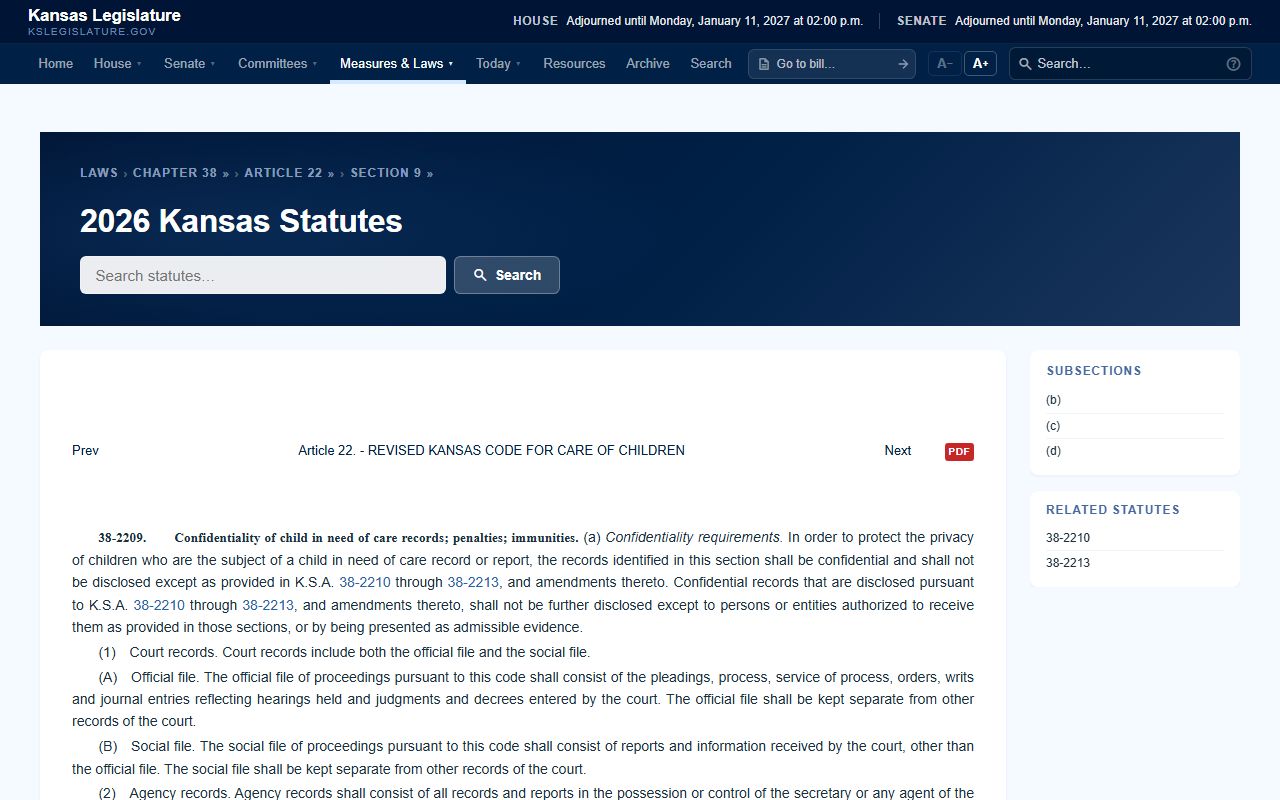
That confidentiality rule is one example of why not all court or arrest-related records can be found through public search.
| Sealed | Expunged | |
|---|---|---|
| Public Search | Record may be hidden or partly blocked. | Record is limited from public access after court order. |
| How It Happens | By law, court rule, or judge's order. | By petition and order when Kansas law allows. |
| Effect | Does not mean the case never existed. | Does not remove every possible agency or statutory access point. |
Restricted Charge Records
Public access to charge records is narrower when a record is juvenile, sealed, expunged, investigation-sensitive, or protected by Kansas law. Criminal history data also has dissemination limits under K.S.A. 22-4701 and K.S.A. 22-4707. Those laws distinguish public court proceedings from criminal justice agency history records. For Graham County, that means a person may need the court docket for filed charges and a separate KBI/Kansas.gov search for statewide criminal history.
Important: Arrest records and court charges should not be treated as convictions unless the docket shows a final conviction disposition.